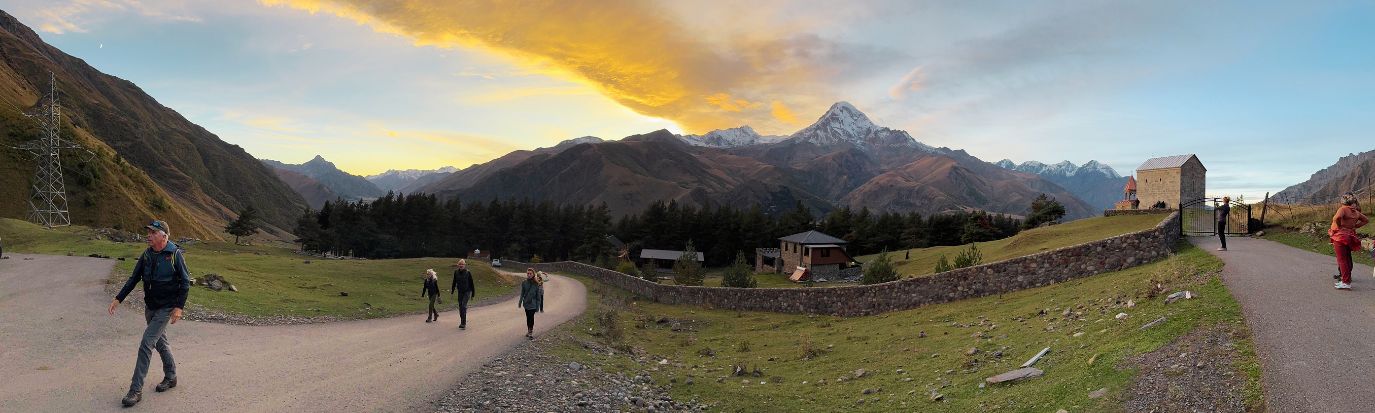
Travel Writer Lori Rackl joined our 2025 Georgia & the Caucasus Mountains Hiking Adventure — and her story has since been picked up by the Tribune News Wire Service and published in papers across the country. With her permission, we’re sharing an overview of what she experienced, in her own words and ours.
When Lori Rackl first told people she was going to Georgia, they assumed she meant the state.
When she clarified she meant the former Soviet republic, the next question was the one she expected: Why? What’s in Georgia?
Her answer, written with characteristic warmth and precision — featured in the Chicago Tribune and now syndicated nationally — is one of the better pieces of travel writing we’ve seen about a destination we love deeply. It is also, for anyone who has been wondering whether Georgia is the right next trip, a remarkably useful and honest account.
What Lori Was Looking For — And What She Found
Lori came to Georgia the way the best travelers come to any destination: without the certainty of what she’d find, but with a clear sense of what she was hoping for. She described being fatigued by the familiar — by a phone full of images of Lake Como and Santorini that made her feel she’d already been there before she’d gone. She wanted somewhere that would genuinely surprise her.
Georgia delivered. Her piece describes a country that has “the main ingredients for my idea of a prime travel destination — interesting history, ample hiking terrain, good food and wine — but would serve these key components in unfamiliar, unexpected ways.”
That framing — familiar ingredients, entirely unfamiliar presentation — is as accurate a one-sentence description of Georgia as we’ve encountered.
Tbilisi: A City Full of Contrasts
The trip began, as ours always do, in Tbilisi — and Lori’s description of the capital captures what makes it so immediately captivating. Glass skyscrapers share space with homes sprouting intricately carved wooden balconies. Brutalist Soviet-era buildings stand alongside ancient Orthodox churches. Elderly women in headscarves sweep sidewalks while teenagers whiz past on electric scooters.
Even the 65-foot Kartlis Deda statue — the iconic “Mother of Georgia” — holds a welcoming bowl of wine in one hand and a sword in the other. As Lori observes, that image says something essential about this country: warm and generous to those who come in peace, formidable to those who don’t. Romans, Mongols, Persians, Ottomans, and Russians have all, as she puts it, “left their fingerprints” on this strategically positioned nation at the crossroads of Europe and Asia.
The political context Lori describes adds another layer: Georgians have been gathering nightly outside parliament to protest what they see as their government’s pro-Russian drift. The country’s Western-leaning citizens want to join the European Union. It is a nation with strong opinions about its own future — and that passion for self-determination is part of what makes Georgians such compelling hosts.

The Mountains: Where Georgia Surprises Most
Lori’s most vivid writing is about the hiking — specifically the Greater Caucasus mountains, where she describes feeling genuinely, pleasantly small.
The Truso Valley hike — a relatively flat five miles past abandoned stone buildings and the crumbling remains of a medieval fortress in a high-altitude gorge — produced one of her favorite lines of the piece. After noting that Georgian Orthodox nuns from a nearby abbey served the group a hearty lunch of lentil soup, beef patties, and cheese pie, and that they barely saw another hiker (“just hundreds of sheep clinging to the grassy slopes”), their guide Emily offered a summary that couldn’t be improved upon: “I like it here because you feel small.”
The Gergeti Trinity Church hike — starting from Rooms Kazbegi hotel (a former Soviet sanatorium that Lori calls her favorite hotel of the trip) — takes you up to a 14th-century church perched at 7,120 feet, with the 16,581-foot Mount Kazbek as backdrop. The view from that church, with the snow-covered peak rising above and the valley spread below, is the kind of image that stays with you.
And then there is the tiny village of Tsdo, three miles from Russia, where the group gathered around a kitchen table for a hands-on lesson making khinkali — the large, garlic-bulb-shaped dumplings that are a Georgian staple — before sitting down to lunch with the family who lived there.

The Wine: 8,000 Years in the Making
Georgia makes a credible claim to being the birthplace of wine — scientists have found wine residue on pottery shards dating to 6,000 B.C., and winemaking traditions that are thousands of years old are still practiced today.
Lori’s account of the Kakheti wine region — Georgia’s wine heartland — includes a visit to Tedo Gzirishvili’s family winery, where the group was shown the egg-shaped clay vessels called qvevri, buried in the ground for fermentation in a process recognized by UNESCO for its cultural heritage. Tedo then invited the group to experience a traditional Georgian feast known as a supra.
Her description of that supra is the emotional peak of the piece: a rustic room warmed by a wood-burning stove, a long wooden table, plates of pickled cabbage and garlic, clay pots of tender beans, platters of chicken and tomatoes and eggplant. Tedo opening bottle after bottle of bold Saperavi red and refilling pitchers of amber wine. Nobody wanting him to stop. Even the cat curled up by the fire seemed, she notes, to be having a good time.
The supra’s tamada — the traditional toastmaster — was Tedo’s cousin Misha, who doesn’t speak English. Their guide Emily translated the toasts: to Georgia, to their ancestors, to health, to good fortune.
The final toast got the loudest cheers.
“To peace,” Emily said, raising her glass.

The Guide Who Made It Possible
Throughout Lori’s piece, the person who makes the country come alive is Emily — Salome Kvaratskhelia, who prefers to go by the name she chose herself. Born in 1991 as the Soviet Union collapsed, from the region of Abkhazia currently occupied by Russia, studying to become a surgeon in her off-season from guiding — Emily is, in every way, a living embodiment of Georgia’s recent history and its forward-looking spirit.
She is the kind of guide who doesn’t just translate language. She translates a country.
Salome has been leading tours in Georgia for eight years and has been described by past Zephyr travelers as having “encyclopedic knowledge of the country’s history, culture, and food” combined with “passion and pride” that made the experience “truly special.”

We’ve Added a 2027 Departure
Lori’s article has been published in papers across the country through the Tribune News Wire Service, and the response has reminded us — if we needed reminding — that Georgia is exactly the kind of destination that rewards people who are willing to go before it becomes the obvious choice.
We have added a 2027 departure for the Georgia & the Caucasus Mountains Hiking Adventure:
September 19–28, 2027 | $5,375 per person
Ten days. Tbilisi, the Caucasus Mountains, the Truso Valley, Gergeti Trinity Church, the cooking class in Tsdo, the Kakheti wine region, a supra at Tedo’s winery, the Cave Town of Uplistsikhe, and the walled city of Sighnaghi. Everything Lori described — and more.
Moderate hiking, 5–8 miles per day on rugged terrain. All meals included except one dinner on your own. Both a Zephyr guide and local guide Salome leading every step.
→ Full itinerary and booking: zephyradventures.com/tour/georgia-hiking/ → Questions: 888-758-8687 | info@zephyradventures.com
We are grateful to Lori Rackl for permission to share her account of our 2025 tour. The full article, “Former Soviet country Georgia is a feast for the senses,” was published in the Chicago Tribune on May 31, 2026, and has been distributed nationally through the Tribune News Wire Service.