Why the Champlain Valley in Vermont is the state’s best-kept cycling secret.
Ask most people about fall in Vermont and they’ll tell you about the Green Mountains — the dramatic north-south spine of the state, the famous gap roads climbing through blazing forests, the postcard peaks that photographers and leaf-peepers descend on every fall. They’re not wrong. The Green Mountains in autumn are genuinely extraordinary.
Vermont is called the Green Mountain State for a reason. Most of the state is relentlessly hilly. The same terrain that looks magnificent from a scenic overlook becomes a series of punishing climbs when you’re on a bike, particularly for riders who want to spend five days moving through the landscape rather than grinding up it.
The alternative is the Champlain Valley — and it’s one of the best-kept secrets in fall cycling in the northeastern United States.
A Different Vermont Entirely
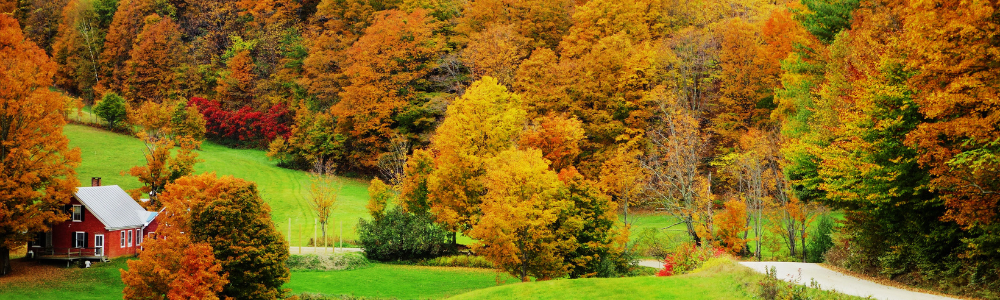
The Champlain Valley runs along Vermont’s western edge, pressed between the Green Mountains to the east and Lake Champlain to the west. The Adirondacks of New York rise beyond the lake. It is more flat here, or close to it — gently rolling agricultural land that opens up into wide-sky vistas unlike anywhere else in Vermont. Farms spread across the valley floor. Old sugar maples line the roads. The light in October, with the sun lower in the sky and the air finally crisp, falls across all of it at an angle that photographers come specifically to find.
For cyclists, this geography is a revelation. Glaciers sculpted the Green Mountains eons ago, but left openings between peaks that offer scenic routes through — rather than around — Vermont’s famous mountain range. In the Champlain Valley, you ride in the valleys of productive land those glaciers left behind, with the mountains visible on both sides as a backdrop rather than an obstacle.
The roads here are predominantly low-traffic, paved country routes threading between small towns that most Vermont visitors never reach. There are no traffic lights on most of them. On a weekday morning in early October, you can ride for an hour and see more cows than cars. It makes for ideal Vermont cycling.
The Towns That Make the Difference
The southern Champlain Valley — roughly the stretch between Middlebury and Brandon, with the farming village of Shoreham tucked in between — is where the most rewarding cycling lives. Each town earns its place on a route.
Middlebury is Vermont’s most celebrated college town, and it shows in the best possible way: a lively, walkable downtown built around Middlebury College, with good restaurants, independent bookshops, and the spectacular cascade of Otter Creek Falls tumbling through the center of town. The Middlebury Inn, a stately Federal-style hotel that has been welcoming travelers since 1827, sits on the town green. It’s the kind of place that makes you want to linger over breakfast longer than you should.
Brandon is smaller and less famous, which is precisely why the New York Times once called it home to “the prettiest street in Vermont.” It’s an arts town — studios and galleries tucked into Victorian storefronts, a lively creative community that settled here decades ago and never left. The Brandon Inn anchors the village green. The mood is unhurried in a way that feels earned rather than performed.
Shoreham barely registers on a map — population around 800 — but it holds a quiet gem: the Shoreham Inn, a 220-year-old country inn with a cozy pub that has been serving travelers for as long as this region has had travelers to serve. Staying here means waking up to rooster sounds rather than traffic, which is its own form of luxury.
Between these three towns, the riding connects them through open farmland, past apple orchards just hitting peak harvest, over covered bridges, and along roads where the only sounds are wind in the maples and the occasional farm dog opinion about your passage.
What Happens When You Ride Alongside the Lake
On certain routes in the valley, the road brings you close enough to Lake Champlain that you can see across its wide surface to the Adirondack peaks in New York. The lake is enormous — 120 miles long, the sixth-largest freshwater lake in the country — and from the Vermont shore in October, with the foliage blazing on both sides of the water, it looks like a painting someone made too beautiful to be believable.
Riding along Lake Champlain’s quiet eastern shore, the Adirondack peaks rising across the water, is one of those cycling experiences that stays with you long after the miles are done. The lake creates its own microclimate — the water moderates temperatures, keeping the valley slightly warmer than the surrounding hills in early fall, and the views across to the Adirondacks in clear morning light are extraordinary.
For those willing to extend a ride, a seven-minute car ferry crosses the lake to Fort Ticonderoga in New York — one of the most significant military fortifications in North American history, built by the French in 1755 and later captured by Ethan Allen and the Green Mountain Boys in 1775. Riding to the ferry landing, crossing the water with your bike, and spending an hour among the 18th-century ramparts before cycling back is the kind of unexpectedly rich experience that the Champlain Valley keeps offering to people willing to wander.
The Food That Belongs to This Landscape
The Champlain Valley is agricultural land, and the food reflects that with a directness that restaurant-focused food tourism rarely achieves. The apple orchards along the lake roads — Champlain Orchards among them — are harvesting throughout October, which means fresh-pressed cider and warm apple pies available at farm stands with no pretense and no markup. This is not farm-to-table as a marketing concept. This is just farms.
Vermont maple syrup at its best is a Champlain Valley product — the sugar maples that line these back roads are the same trees that produce it, and stopping at a sugarhouse to taste the grades side by side is a genuinely educational pleasure. The difference between Grade A Golden and Grade A Dark is not subtle once you understand it.
Middlebury’s Otter Creek Bakery has been providing cyclists with morning fuel for years, their pastries appearing on Zephyr route notes the way reliable landmarks do — not because someone arranged it, but because it’s simply where you go. The restaurants in these towns — from the elegant Morgan’s Tavern at the Middlebury Inn to the cheerfully eccentric Fire & Ice in town — cook with ingredients that came from within a county’s drive.
October is a Great Month
Vermont’s Champlain Valley offers some of the best fall foliage viewing in the state, and October is a good time to go to help ensure full color at its peak in the southern valley. The swamp maples along the Otter Creek corridor go first, turning scarlet in late September. The sugar maples and ashes follow through mid-October, painting the roadside trees in combinations of orange, yellow, and deep red that photographers specifically travel here to find.
The temperatures in October are ideal for cycling in Vermont — cool enough that sustained effort feels good, warm enough in the afternoons that a rest stop in a sunny spot is a pleasure rather than a shiver. The light is extraordinary at this latitude and this time of year: long golden mornings and long golden evenings, with the low sun catching the lake surface and the turning leaves at angles that flatten out in the high summer.
Foliage timing in the Champlain Valley typically runs a week or two behind the higher elevations of Vermont’s interior, which means the valley catches its peak color while the mountains are already past peak. This also means the leaf-peeper traffic that clogs Route 100 and the mountain passes has already crested — the valley roads in mid-October are quiet.
Practical Notes for Cycling This Region
A few things worth knowing if you’re planning to cycle the Champlain Valley on your own:
The riding is genuinely accessible. Most of the routes between Middlebury, Brandon, and Shoreham are rolling rather than flat, with nothing that would be called a serious climb. The Vermont Land Trust has mapped several bike loops through the Champlain Valley — including a Shoreham Loop of 19.4 miles and a Vergennes-Middlebury Loop of 27 miles — all on low-traffic roads through protected farmland. These are well-suited to a range of cyclists.
E-bikes make this accessible to almost everyone. The rolling terrain of the valley is manageable on a standard road or hybrid bike, and the addition of pedal assist makes it genuinely easy for riders who want to cover more miles or simply enjoy the views rather than the effort.
The cycling season runs through mid-October. The cycling season in the Champlain Valley runs from about the beginning of May through about the third week of October, though early October is widely considered the peak for both foliage and riding conditions.
Inn-to-inn is the ideal format. The distance between Middlebury, Brandon, and Shoreham is comfortably bikeable in a day each way, making this one of the most natural inn-to-inn cycling routes in New England. Staying in each town means experiencing it rather than just passing through.
Experiencing It With a Guide
For cyclists who want the logistics handled — routes optimized, accommodations chosen, luggage shuttled between inns so you carry only a daypack — our Vermont Fall Biking & E-Biking Adventure is based in Middlebury with overnights in Brandon and Shoreham. It’s a five-day loop through the southern Champlain Valley, with multiple daily route options so you ride as much or as little as conditions and inclination suggest. E-bikes are available for riders who want them.
Details and dates: zephyradventures.com/tour/vermont-fall-biking/
The Champlain Valley won’t make the front page of the Vermont tourism brochure. That’s part of what makes it so good. October is short. The maples do what they do with or without an audience. You might as well be there.